
Vietnam
Three weeks in Vietnam – a trek from north to south, trying to avoid busses as much as possible.
Goodness, apologies in advance, because this is another long one. It’s all about Vietnam, and the fact that I am back in Vietnam is a testament to how long this trip has become. I first visited Vietnam three years ago, and hated it. Well, “hated” may be a bit strong, but it did not leave a very favorable impression. Saigon was a riot of motorbikes, the city was overrun by backpackers and heading to the Mekong Delta did little more than make one sweat and wonder why the heck you were there in the first place.
But, this Asia trip has become such a long one that I had an extra period of time — about four weeks — when I had no clear destination or itinerary. I had never seriously considered coming back to Vietnam. I even had about $50 in Vietnamese currency that I left back in Chicago. But after doing some research, I realized there were some parts that merited further review. I quickly came up with an itinerary and decided to spend three weeks in Vietnam, seeing things in the northern and central parts of the country. Surprisingly, I didn’t have enough time – there are still numerous places I’d like to visit that I just could not squeeze into this trip.
Now, you may wonder why I didn’t like it in the first place, and if things have changed since then. Oddly enough, I’d have to say they haven’t. Vietnam is different in large part because it is very much unlike the rest of SE Asia. You often get this tourism bureau version of this part of the world – smiling people, happy faces. For the most part, that’s true. Indonesia and Thailand in particular are among the friendliest, warmest and most service-oriented places I’ve ever been. Vietnam can sometimes feel like pretty much the opposite of that.
Things are inexpensive, but you have to be constantly vigilant about being gouged. It can be innocuous, like $2 for a $1 bag of peanuts, but it’s the sheer prevalence that makes it frustrating, e.g. the majority of taxis I took had malfunctioning meters that I had to complain about or took a circuitous route because of “construction” or “police”. Or the hotel that “forgets” that you’ve already paid for laundry. Or the restaurant that charges you the same for a piece of bread as a piece of bread with two eggs. I don’t think this is merely a string of bad luck – it’s something i’ve seen mentioned pretty regularly in blogs and travel reports, and certainly for me, it’s something I’ve really only seen in Vietnam. Look, every place has a “tourist tax” of some sort, but it’s the array of issues in Vietnam that makes it unique. Unfortunately, it also colors your interaction with people, because you inevitably feel like a walking cash machine, accosted by store owners, restaurants, guys on motorbikes, etc. It happens a lot of places, but Vietnam seems to have taken it to a different level.
Some of you may wonder if it has anything to do with the war. I don’t think so. I’m guessing that many of you were affected in some way by the Vietnam War, either personally or via your friends and family. Obviously, one has to operate under the same assumption here in Vietnam. But there appears to be no lingering anti-Americanism on display. Rather, a general gruffness and brusqueness pervades most transactions here. Sure, they want you to shop in their shops and eat in their restaurants, but beyond that there isn’t much in terms of the pleasantries we’d expect from commercial transactions.
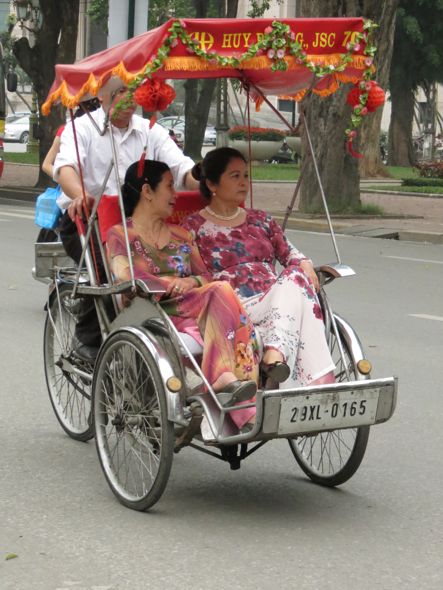
So why did I come? Well, the country is seeing rapid tourism growth because it has much to offer. I started in Hanoi. Its French colonial architecture, nationalist sites like the Ho Chi Minh mausoleum and numerous lakes studded throughout the city make it almost delightful, which is surprising for an Asian capital. The hotels and the opera house have been restored, new design shops have popped up, and I found the city buses easy to navigate. Daily life is colorful.
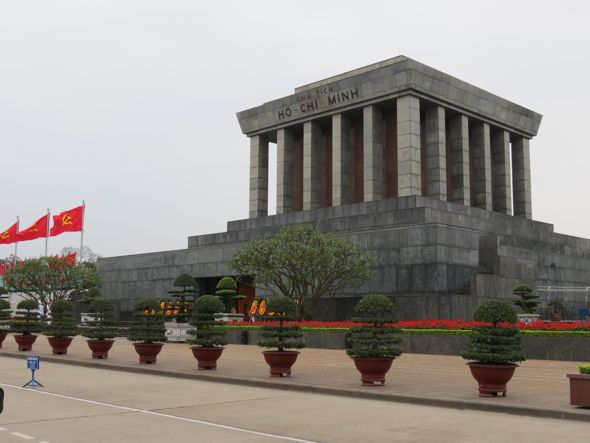
And though Saigon was named for Ho Chi Minh, his legacy is tended to from Hanoi. Despite his wishes, his body was embalmed and placed in a prominent mausoleum. There is also a significant museum detailing his life and political ideology.
I also went to NInh Binh and Ha Long Bay. Both have limestone outcroppings and make for some spectacular viewing. Ninh Binh is like a small version of Ha Long, but on land. It’s quite pretty, though there are only three caves.
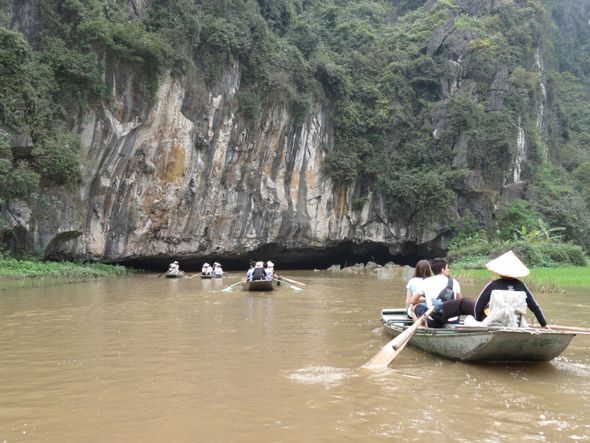
The boatsmen – who are overwhelmingly women, btw — use a peculiar technique of alternating their rowing. Half the time, they use their feet to row.

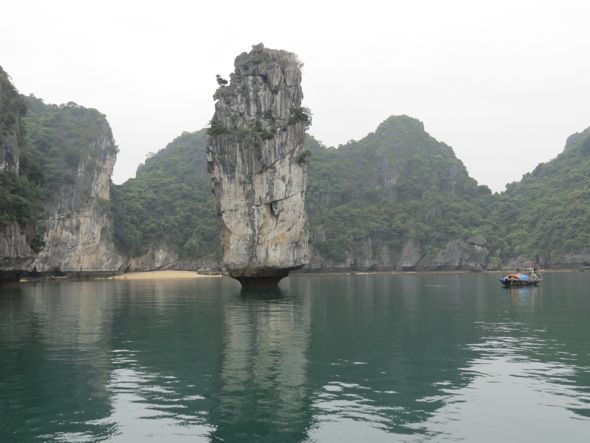
Ha Long is of course a UNESCO heritage site and has also been voted one of the seven natural wonders of the world. It’s mystical, beautiful, and unforgettable. I had only one day, which is actually enough. Despite its eeriness and mystery, it is so placid and disorienting that you feel fairly immersed rather quickly. I had read tales of loads of boats and crazy water traffic, but my tour didn’t really see much of that, and aside from the stop at one of the natural caves, we were pretty much on our own – you’ll learn how much further down.
Before we continue south, one quick aside. I thought that after Burma I’d be done with commenting on currency, but Vietnam presents its own challenges. First, the low value of the dong makes it difficult to keep the zeroes straight. One U.S. dollar is about 20,800 dong. Yes, twenty thousand. So a coke is 10,000, water is 7,000, and hotels quickly hit a half-million or more. Though you think they’d create a shorthand by knocking off the thousands, shopkeepers still use calculators for almost every transaction, and dutifully tap out the zeroes.
But all that is bearable. What makes matters hilarious is the sheer variety of bills they have, with a particular affection for bills starting in 2. They have bills for the following:
500
1,000
2,000
5,000
10,000
20,000
50,000
100,000
200,000
500,000
Each ostensibly has a color, but the same bill can have different hues, owing to its age and version, e.g. the red 50,000 comes in rose and red. It’s insane.
I mentioned before that there are some places that just “click” for you. Vietnam isn’t one of them – but there is a pretty well developed tourism infrastructure, and outstanding sites, and that helps enormously, because yours is a shared experience with all the other out-of-sort Westerners. One constant of travel in Vietnam is an overwhelming sense of disorientation. This is for a couple of reasons.
Obviously, the language is exceedingly difficult and not rapidly learned. Though it uses Roman script, I find that it can best be described as high-pitched, loud, grating and relentless. And those are its more positive aspects, as it is also glottal, maddeningly studded with diacritical marks, and resembles a staccato attack of consonants and vowels. I know that my language likes and dislikes are idiosyncratic, e.g. I hate French but love Swedish, but Vietnamese is something I think we can all agree is an acquired taste.
But more than the language is the way business is done here with tourists, specifically when it comes to tours. Normally, I detest group tours – can’t stand them. But Vietnam’s tourism infrastructure began in a very bifurcated way – $300/night hotels for businessmen, and $5-10/night places for backpackers, with not much in between. Those backpackers places generally are full-service travel agencies, buying bus tickets, offering tours, renting bikes, etc. The tours they offer are dirt cheap – $5-15 for a full day, including lunch. Oddly, there are no tuk-tuks, taxis are rather expensive in Vietnam, and regional buses are not as prevalent as in Thailand, so if you want to get to a place that is not within walking distance of your hotel, and like me, you want to avoid motorbikes, the tours are not only incredibly efficient, but much, much cheaper than trying to hire a driver. I did Ninh Binh independently, because i didn’t want to start at 8am, but it really wasn’t worth the hassle – I think I paid more, the regional bus was grossly overcrowded – 42 people in a 26-seat minivan – and I even got a cab driver who “didn’t know” where the bus station was, so I had to direct him.
On balance, the tours make sense because they eliminate the hassle of arranging transport, but expect the unexpected, because even though you’ll be given a list of places you’ll see, you remain at the whim of the tour guide. Boating through Ha Long Bay was my first reminder of the unique way that package travel and tours are handled in Vietnam.
Now doing only one day in Ha Long Bay sounds crazy, in part because it’s not all that close to Hanoi. I had to take a city bus to an outlying bus station, then regional bus to Haiphong, then minivan to the pier, boat to another pier, and finally shuttle bus to Cat Ba. Five hours, but all for $9. As expected, I checked into my hotel and the manager signed me up for a full day Ha Long Bay tour. It was a pricey $20, but included special transport back, as I had to leave a bit early to catch my bus back to Hanoi, e.g. back in Cat Ba at 4p instead of 5p, with the rest of the tour. Details were sketchy – you are given a list of things you’ll see, but no more, and I had no idea how I’d get back early. But that’s Vietnam – no tickets, no promises, just follow the gringos.
The next morning he led me to the pier. I got on a boat with a few other Westerners, and we set off through the bay. We stopped for kayaking — first time I have ever kayaked! (I have canoed before, but this was totally cool and I am completely stoked about doing it again – so let me know who’s interested.)
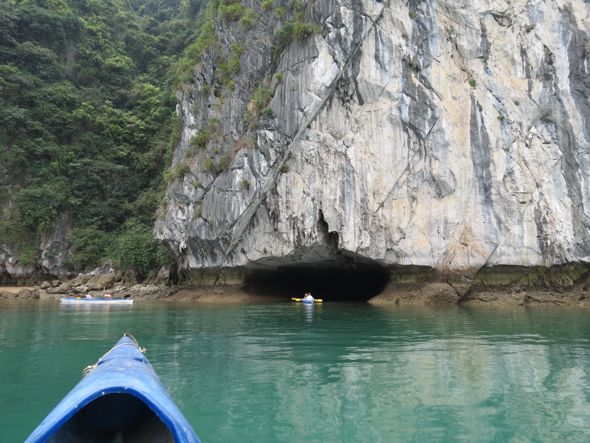
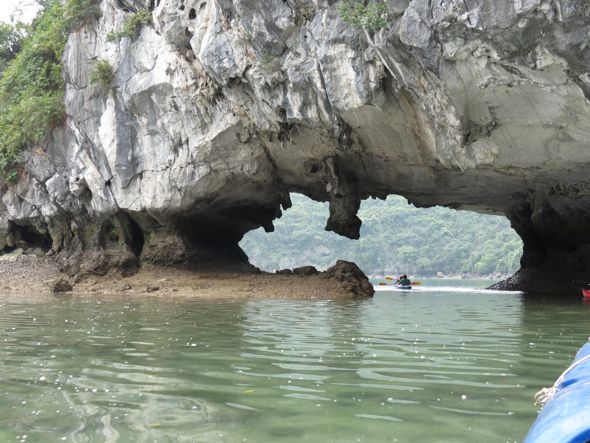
Then we went to a cave, lunch on the boat and then a lazy two hour cruise in the bay.
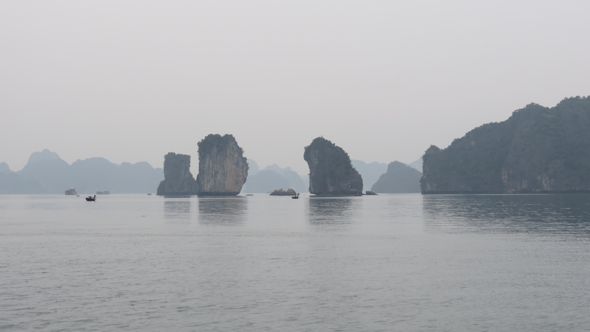
I was beginning to worry a bit about making my bus, as it was 2.45p and we were in the veritable middle of nowhere, when suddenly a small boat – more of a flattened canoe, frankly – edged itself beside us, and I was told to get on. Apparently, this was my ride to get the bus to Hanoi! I loved it – I got on, the rest of the passengers were shocked and I waved goodbye, whisked away into the mist. From there, I was dropped off at a pier.
Kinda cool, right? Well, that’s where things got even more interesting. First, I have avoided motorbikes throughout this trip, but it’s impossible in Vietnam. I had to use them three times – and the lone guy waiting for me at the pier was my first – we went over the hills and back to Cat Ba, to catch my shuttle bus, boat, shuttle bus, bus return trip to Hanoi.
Second, as I got on the big bus to get back to Hanoi, I asked if I could go to the bathroom, but was given a wave of “later”. The shuttle bus, boat, shuttle bus combo didn’t have a bathroom, and the big buses don’t either, and I knew it would be well over two hours back to Hanoi, and probably three to my hotel. On the road, about fifteen minutes later, the bus attendant asked if I needed to use the toilet. I said yes and he motioned for me to come to the front. The bus stopped and he told me to get out.
Now let me explain that we hadn’t miraculously stopped at another bus station, or even a roadside restaurant. We paused on the side of the main road to Hanoi, about 50 meters from a bridge, next to a darkened, apparently abandoned building. It was L-shaped, facing the road, and as I got out, a woman darted past me, stepped into the darkness at the point of the L and dropped trou. Just like that, facing the main road, horns ablaring. Now I certainly wasn’t going to relieve myself next to her, so I and another guy ran to the other side of the building, closer to the bridge, since we only had “No. 1” business to deal with. The bus started honking, the woman was racing back to the bus and in the midst of this chaos, a man who apparently lived in this unfortunate building came out and started yelling at us! Hands down, worst toilet break I’ve ever experienced. LOL
So with all this chaos, is it worth it? Yes, of course, but it is a hardier experience than places like Thailand or even Indonesia. The main buses between cities are often icky sleeper buses, which are essentially open coffins. And here’s the view from my seat.
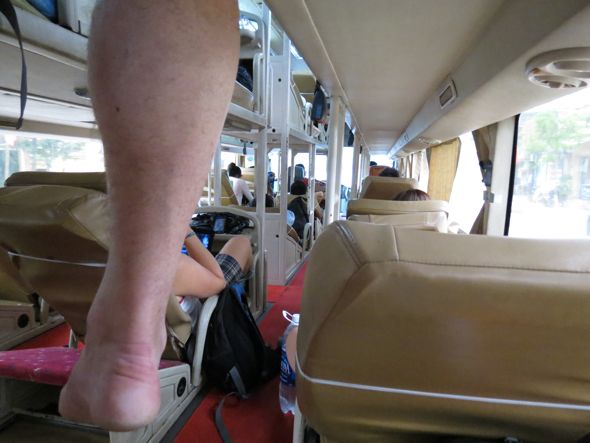
The regular ones are worse – Viet pop blaring, iffy a/c, scary drivers and incredibly long journeys. Also, though there is air service everywhere, it’s primarily to and from either Hanoi or Ho Chi Minh City, otherwise, flights are often sold out and not frequent, e.g. flight from Da Nang to Nha Trang was sold out for weeks when thankfully two seats opened at the last minute, and there wasn’t a single Vietnamese passenger on board.
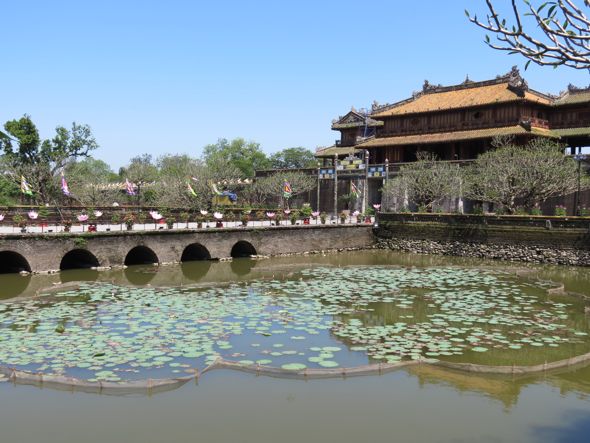
But some of the sights are surprising. Hue, the capital of the Nguyen dynasty, which lasted into the 20th Century, is frankly stunning. The Citadel, which is being rebuilt, is a smaller version of the Forbidden City, with oddly modern touches like one of the King’s tennis courts.
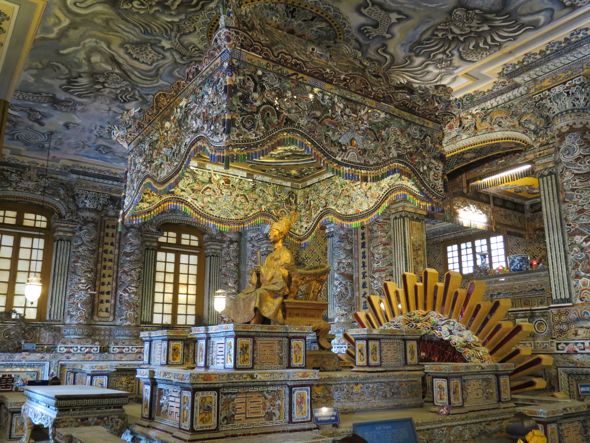
The royal tombs that surround the city are also magnificent. The ornamentation in this mausoleum was breathtaking.
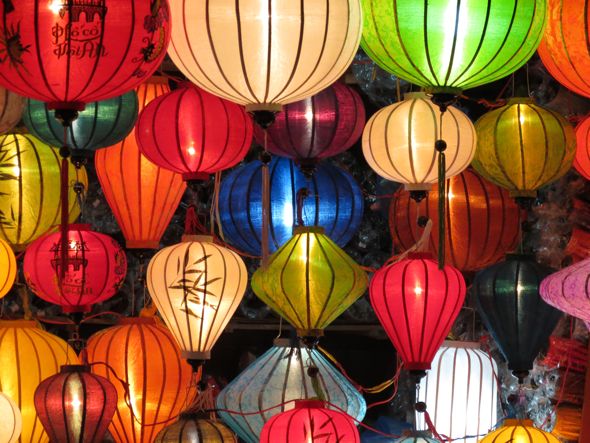
Hoi An is an ancient city that when lit up at night is frankly charming, a word that I rarely use and that almost never comes to mind when thinking of SE Asia. Yes, it’s overrun with tourists, but still has such a cool, laid back vibe that it’s well worth a stop of several days. And I say that even though it “rained” in my hotel room — yes, rained, there was some massive leak from upstairs and water started to pour from the ceiling.
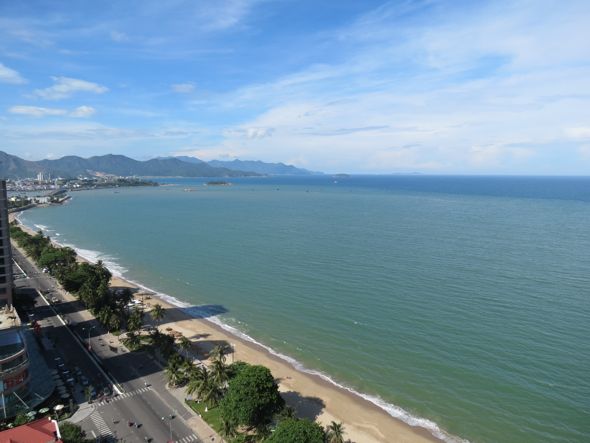
Nha Trang has some great beaches, This was my recharge zone, as I stayed at the Sheraton there – exquisite. I didn’t do much but stare out from the balcony after getting in the water.
And Dalat, which is a major Vietnamese tourism destination is nestled in the hills above Nha Trang. The drive up was one of the most beautiful I have ever taken. I also continued my frenzy for all things cable car in Vietnam and went on not one but two. The first in Nha Trang is billed as the world’s longest. I think they mean on one cable, as the Hong Kong one is much further, but has transfer stations. And I did a smaller one in Dalat, which was strange not so much for the height as that it was virtually empty on a Sunday afternoon. It’s undeniably strange to be traveling on a seemingly abandoned cable car line.

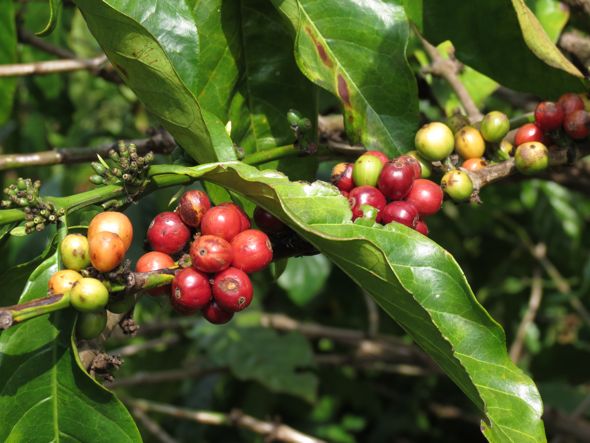
Near the end of my time I decided to go off the tourist track and ended up in Buon Ma Thuot, coffee capital of Vietnam. Very little English is spoken and I had to resort to invading the kitchen and pointing at things again. The waitresses were fascinated by my Kindle. The coffee is excellent though – delivered in small, espresso-sized amounts. It’s inky yet smooth, bitter yet not overly robust, with significant undertones of chocolate. It’s also served in these intricate metal filter mechanisms, and oddly for a cafe, everyone gets free tea. I think it’s like giving free pork ribs at a fried chicken restaurant.
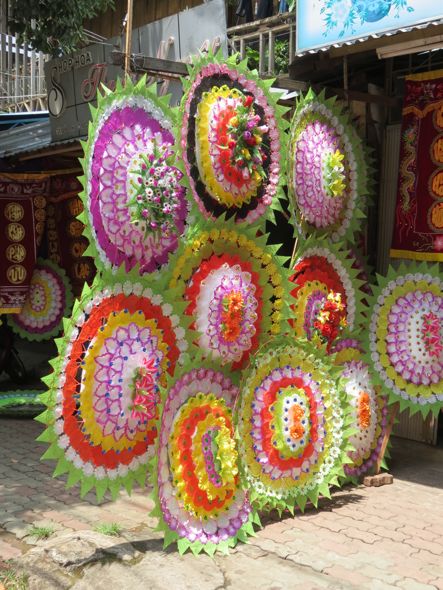
One great thing this kind of an extended trip offers is a chance to see differences and similarities across Asia. We tend to think of it monolithically, but it certainly isn’t. Still, some things are constants, so I’ll leave you with one of them — wherever you are, flowers all look like they’re made for funerals. It’s odd, considering how disordered so much of the continent is, but most certainly not in its intricate, precise floral arrangements.
The big news I have is that after a recharge weekend with friends in Singapore, I have decided to return to Myanmar/Burma. There was a site I specifically wanted to visit, but which is not that easy to get to. I’ll be going back later this week! And for those wondering, it looks like I’ll be back my mid-August.
 WHERE IS JAVIER?