
Cambodia
The treasures of Angkor Wat, a new cosmopolitanism in Phnom Penh, and the harrowing legacy of Pol Pot’s regime.
This update comes a bit sooner than expected, and is a bit longer than I’d like, but it also marks a transition point between two very distinct experiences, so I thought it best to give you a summary of the first. I’ve spent most of the time since my last update focused on the Khmer Empire, including the Angkor Wat complex and one temple that may have served as a template of sorts in Thailand.
After the beach vacation in Langkawi. my friend and I did one of those “travel days” that are an unavoidable fact of traveling through Asia. You have to set aside a day to get where you’re going, and you try to make the best of it. Ours was a relatively easy one — quick trip to the airport in Langkawi, Starbucks for me (where the staff incorrectly christened me and my cup “Abdullah” for the days we were there, flight to Kuala Lumpur, another flight to Phnom Penh and then a dizzying tuk-tuk ride to our hotel. A relatively quick nine hours in all, but I was fortified.

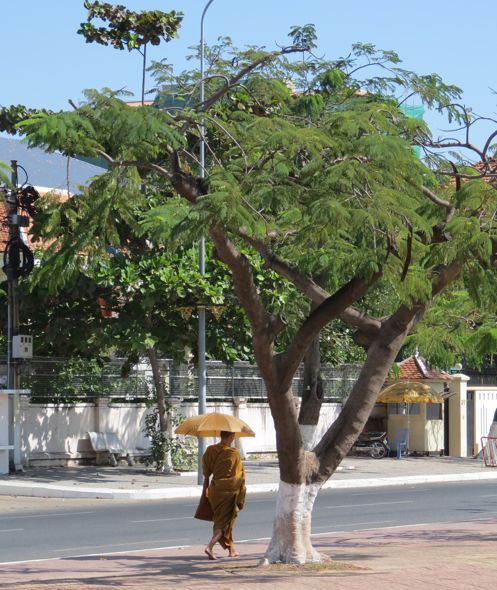
Phnom Penh has been generously described as a backwater, a hole filled with dung, a place best skipped. Perhaps the rule of lowered expectations was at play, but I thoroughly enjoyed our two days there, and would have happily added a couple more. I was expecting a poorer version of Saigon, but that was not the case. The traffic flowed relatively freely, there weren’t swarms of motorbikes, and a burgeoning design-focused area near the Palace offered great accommodations, excellent food and nice shopping. The bones of the French colonial city gave Phnom Penh grand boulevards, a walkable area along the river, and several parks. I caught one monk rushing along.
But the city is also a harrowing experience, as we went to both the Genocide Museum, housed in the former central prison run the Khmer Rouge, and later to the notorious Killing Fields. The Museum includes photographs of the many who died there. Most of the rooms have been left as is, including the crude brick “cells” they constructed. Others, for higher officials, had doors, but they were little more than cages for the condemned. The prison was once a school, so you are forced to imagine the dissonance between its two uses.
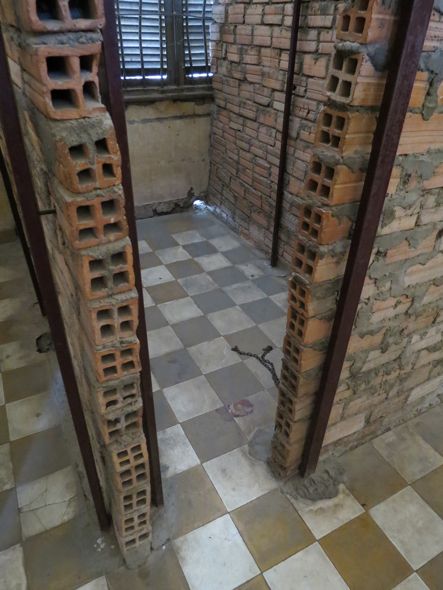
I consider myself a rather rational person, and despite my religious beliefs, don’t indulge much in exploration of spirits or other “senses”, but this room in the prison seemed to concentrate the evil energy coursing through the place. it’s just a small space hidden under a staircase, presumably a storage or maintenance closet of some sort when it was a school. But I physically could not enter the space – I was both repulsed and fearful.

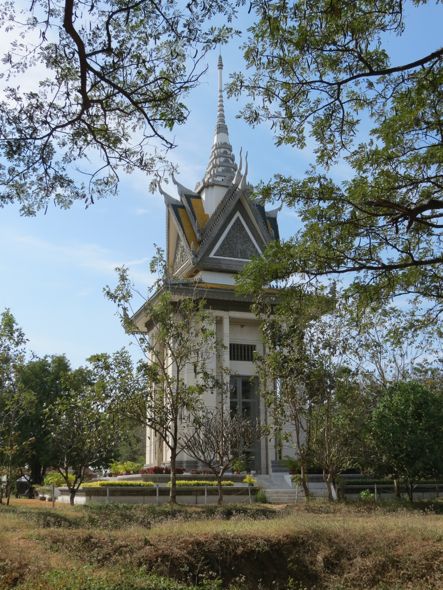
The millions that died are made manifest at the Killing Fields, site of many, many mass graves. It is one of the many such sites found all over Cambodia. The audio guide of the Killing Fields was outstanding – and I normally hate those things. It was narrated by a survivor, and included snippets of interviews of others who made it through the carnage. Later in the week I picked up a memoir of one survivor, First They Killed My Father, by Luong Ung. HIghly recommended, though also emotionally gut-wrenching. This is the memorial tower at the Killing Fields. I’m sparing you the more graphic pictures, as many of the bones and skulls found at this site are housed in the tower. What distinguishes this Cambodian experience was the crudeness, the almost medieval killing methods they employed, leaving a significant, tactile record of the carnage. It’s well worth it to learn more about this historical period.
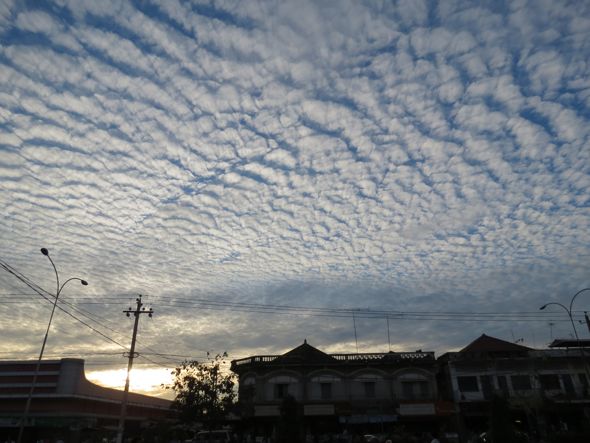
One of the things I love about Asia today is the proliferation of low-cost airlines. AirAsia is a personal favorite, and I have used them extensively. Unfortunately, there are still areas where there isn’t a good air option, either for safety reasons or airfare. Usually I take trains, but that’s not a possibility in Cambodia. So we went with a “minivan option”. The hotel assured us it was “comfortable”, though I believe she meant comfortable if you are under 5 feet tall and 100 pounds. I wedged my way into the back, and submitted to the bone-rattling, swerving, honking ride. Our driver even dislodged the back door on one of his “flights” over a road bump, though thankfully none of the bags fell out. Supposedly the benefit of this method of travel is that you save an hour over the bus. Needless to say, you won’t see any further reports about minivan travel. But i did see this nice sunset during our pit stop.
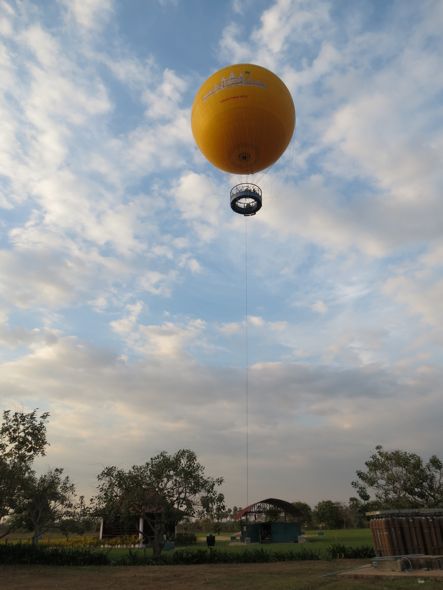
And so we finally arrived to Siem Reap and Angkor Wat. We planned three full days there, and could easily have used seven. The place is vast, massive really. Numerous temples to climb, a hill to scale, and even a balloon ride are all to be found there. It’s not only physically but also visually exhausting, which is why I could have used extra days. Despite the crowds at the major sites, the outer sites are often quite deserted. To get a sense of the scale, we climbed aboard the tethered balloon. There seems to be a theme with this trip and heights.
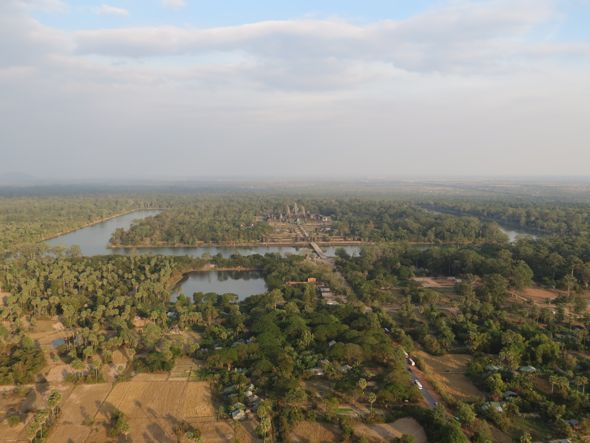
With something this size, it’s almost impossible to describe, or even illustrate. So let me try by showing a series of shots, from expansive to detailed. This is the Angkor Wat site from the balloon. Note the huge moat surrounding the complex. You cant see any of the other temples, but to give you a sense, this doesn’t show any part of Angkor Thom, which is a separate city, with multiple sites and an enormous temple complex of its own. It’s probably 10 times the size of the Angkor Wat complex! And of course there are other temples and sites in the area as well, as well as two reservoirs. One is dry now, the other has water – each is five miles by three miles.
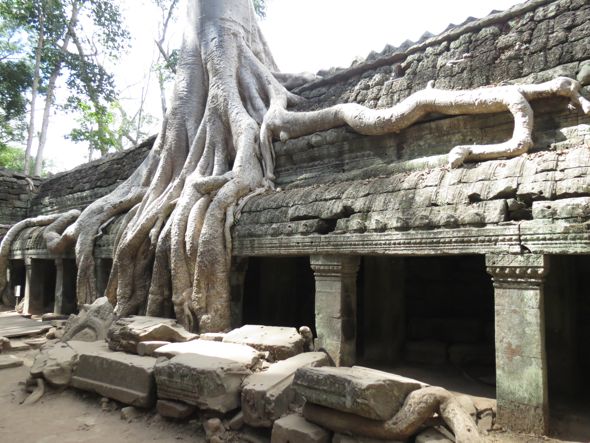
From the wide angle view, let’s move to the Tomb Raider look. Ta Prohm was left much like it was found when archaeologists first began exploring the area, so it has many of those trees growing through the edifice. The issue of how much to restore is always challenging, and at a place like Angkor, which in many places already succumbed to the jungle once, it’s even more complicated. I was surprised to find that individual temple sites are managed jointly by the Cambodian agency and another foreign one. Japan, Germany, China, India, etc all have temples.
LIght is incredibly important to both photograph and appreciate the temples, as much of the stone is dark, and difficult to discern in less than ideal conditions. On the whole, we were very lucky, and got pretty good light. This is Bayon, the centerpiece of Angkor Thom.
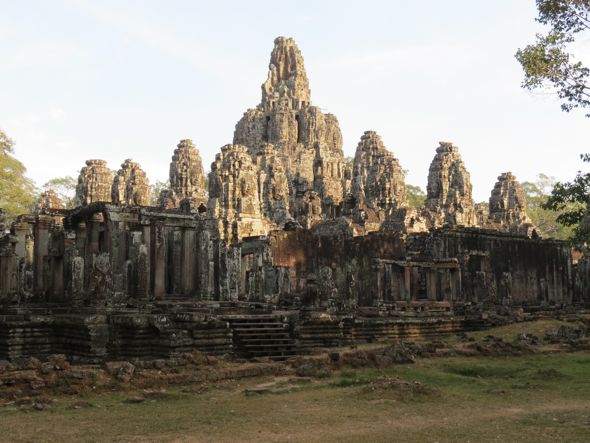
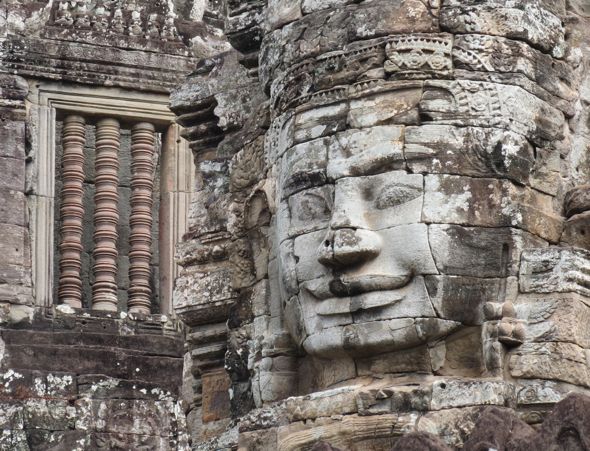
One of the challenges with Angkor Wat is that construction spanned much time, and different styles are represented. This image combines two singular themes – the multi-faced towers throughout the Bayon site, and the stone balustrade windows.
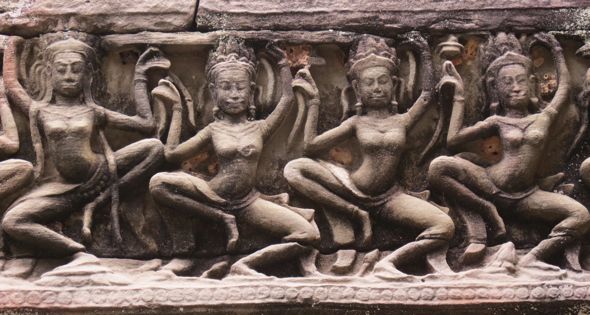
One of the treasures of the sites is the number of details to draw your eye. I struggled to pick amid the myriad carvings and statues. I like the energy of the ladies in this one.
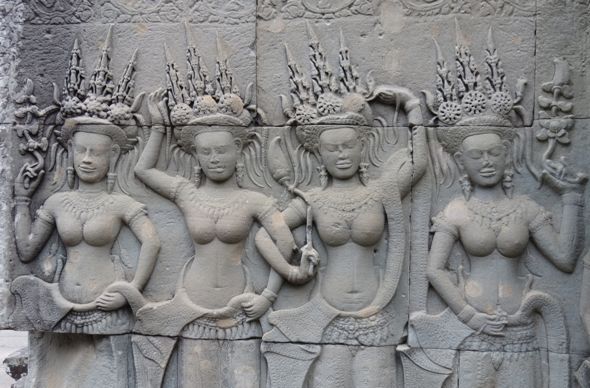
But the detail and ornamentation in this is also quite striking.
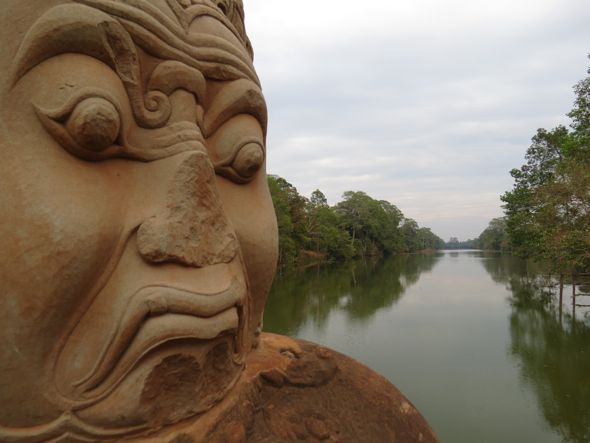
What was most surprising was the beauty of the landscape itself. I’ve visited similar sites that had been changed radically, either returned to the jungle or taken over by commercial zones. But Angkor Wat has worked to protect some of the prettier vistas. Admittedly, this giant head is a reconstruction, but it still frames the river well.
After all that Angkor Wat, I pretty much felt like this.

But i wanted to catch a good shot of those elusive Buddhist monks. They are all over angkor, and the brilliance of their colored robes contrasts in stunning ways against the temples. But they all are very fast — they know they’re being photographed, but do little to help the process along. As I was leaving Angkor Wat for the last time, we stumbled upon this monk. He was the most accommodating one we saw, and was laughing and playing with some of the children nearby.

We did do a couple trips to the night market so my friend could get the fish foot massage. (I passed and I’ll skip the foot and fish photo, it looks as weird as you think it would). And then we were ready to get to Thailand. We had another “travel day” — 12 hours. Three hour cab to Poipet, an hour crossing the Cambodian border, walk to the Thai border, another hour waiting to enter Thailand, tuk-tuk to bus station, four-hour bus to Bangkok, taxi to Skytrain station, and then Skytrain to hotel and airport, as my friend had to go back. Exhausting.
I spent the last few days in Thailand handling some paperwork and also made it to one of the Angkor temples there, Phimai. It was nice to have extra time to focus on just one temple. And now I’m in Bangkok – more on that city later, as I plan to come back for an extended stay in March. But thought I’d share a funny sign from the Skytrain.

The big news is that I am heading to Burma (or Myanmar if you prefer) for two weeks starting tomorrow! I hadn’t planned to go there, but with the recent moves by the government, it should be an exciting time. I got the visa on the day the U.S. reinstated full diplomatic relations last week. It’s definitely off the grid. More when I return.
 WHERE IS JAVIER?