
Myanmar/Burma – Yangon and Inle Lake
Mingalaba! Burma amazes and surprises, beginning what I believe will be a life-long relationship. Wish I had arrived earlier.
OK everyone, hold on because this is going to be a long one. Apologies, because there is simply no other way, given that we are speaking of Myanmar/Burma, the great undiscovered country, and I believe only one of you on this email string has visited there – and that was many years ago.
I began with the impressions that my friend shared with me — a fascinating landscape that requires significant time and patience, but one that rewards with visual splendor. Its remoteness and inaccessibility is undoubtedly one of its draws, but it’s definitely not North Korea. There is a steady trickle of tourists, more than you would expect in certain areas, and some of the locals have quickly adapted to interaction with tourists, in ways both positive and negative. Frankly, I think I saw more tourists in Myanmar than I did in Uzbekistan.
It is also a vast place, with a population of almost 60 million, and an infrastructure that albeit improving, remains very vexsome to a traveler like me, who prefers to have a plan with advance reservations. I worked with a travel agency to establish the broad outlines of my trip — and to importantly get me flight tickets — which you can not buy online and are actually twice the price if you buy directly from the airlines. But the agency was not able to fill in all my plans, and that proved an adventure, but also part of the experience.
Sadly, there is no way for me to describe many of the small details that woven together created the tapestry of my experience there. The policeman who advised me how to find the best spot to take pictures as we passed the Gotkeik Viaduct, the military officer who admonished my moto-truck driver to take special care of me, the child monks who showed me the dirt path I couldn’t find, or the elderly ladies who smiled as they smoked a massive cigar and balanced many kilos on their heads. But I shall endeavor to give you a taste of this place.
First a word on the money situation, because that has been much discussed. The official exchange rate is 6.5 or so kyat (pronounced “chat”) to the dollar, but the black market rate fluctuates a bit. The rate seems to be better in Yangon, less so in smaller cities, and significantly smaller when dealing with individual merchants. So I got 820 in Yangon exchange houses, 800 in Yangon restaurants, but at times had to use a few dollars at rates closer to 650. I incorrectly thought it was like Cambodia, where the dollar is the de facto currency and their rials are used primarily for change. That is definitely not the case in Burma, where merchants prefer kyat, though many things – such as plane/train tickets, hotels and entrance fees are charged exclusively in dollars.
It was one of the most confusing currency situations I have ever been in. And it led me to underestimate the number of kyat I would need — well, that, and the prices in Inle Lake. Overriding all this is the particular rules they have about which bills they will accept. As a general rule, only series 2006 and newer bills are accepted. Bills must have no markings, tears, smudges, inkings, folds, etc., in any way, and that includes innocuous stamps that money counters might place on bills — not acceptable. And C-notes with CB series numbers are also rejected, because apparently there was excessive counterfeiting a while back. These were rejected – see the tiny marks on the right?
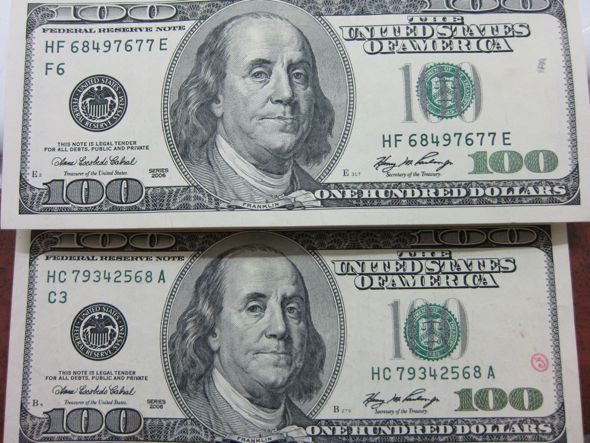
I knew this going in, and had prepared by madly withdrawing money via ATMs and exchanging them for dollars, but still ended up with well over a thousand in unchangeable bills. Needless to say, there are no international ATMs and credit cards are not accepted, so the only way to get kyat is to bring dollars. I did get around it a little by pre-booking via internet and getting some hotel vouchers that were charged to my credit card, though I imagine I paid a premium for that as well.
If you read the one English guidebook about Burma – Lonely Planet – you’ll find encomiums about its “gentle people”, their “stoic humanity” and the “spontaneous delight of its long-suffering people”. The natural cynic and born journalist in me responds to that with a dose of healthy skepticism. I don’t think any place can be truly “untainted”, and even if it is, the people will inevitably be changed by interaction with others by the time we get there.
Still, there are some realities that reflect the lack of interaction with the West. There is much advertising, but it is essentially stripped of Western brands. You can find colas, but other than some smuggled Coke, you are limited to the local Star, Crusher, Quench and Max Plus. People are inquisitive about your country, and outside the main tourist areas are genuinely open and talkative, eager to practice English and learn why you have decided to come to Burma. There are government signs admonishing people to “warmly welcome and take care of tourists”, though I imagine most people would anyway.
Given the incredible difficulty and restrictiveness of the Burmese land borders, almost everyone enters the country in Yangon. Most people use it as a quick transfer point to other parts of the country, but I found it quite fascinating. The vast, ordered grid of streets, a remnant of the colonial period, is enhanced by two large lakes in the northern part, encircled by tree-lined boulevards. Though traffic is busy, it was orderly. Ironically, it has among the cheapest cabs in SE Asia, yet is one of the few cities that has walkable areas.
The first surprise was the overwhelming anonymity I felt. Aside from a literal handful of Westerners, you are not only alone, but left alone, save the occasional money changer. The city’s market areas are incredibly robust, and I saw even more energy because Chinese New Year approached. Much of the city is lived in the side streets, but even the main arteries are filled with an energy and vigor. Sadly, many of the colonial buildings have been left to crumble, but the City Hall, nestled next to Sule Paya, is impressive.
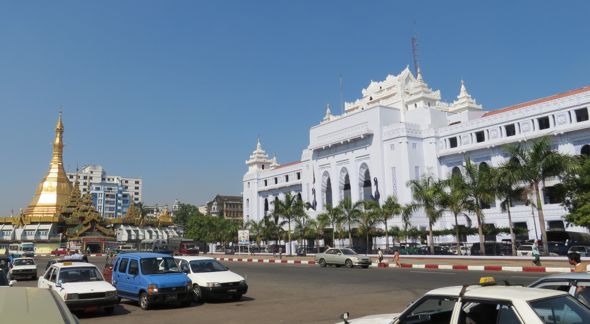
Look at the cars in the picture – you may have owned one 20 years ago. The favored cars on the street are rusting(-ed) mid-80s Japanese four-door sedans – Toyota, Datsun, etc. Given government taxes, they are surprisingly expensive, and since most are cast-offs from Japan, the steering wheels are on the right side. Unfortunately, since the ruling junta wanted to further distance itself from its colonial past, they also mandated that cars should drive on the right, making for some massive blind spots on the left side of the car. Some buses are also boarded from the streets – but as with most things in Burma, you adjust.
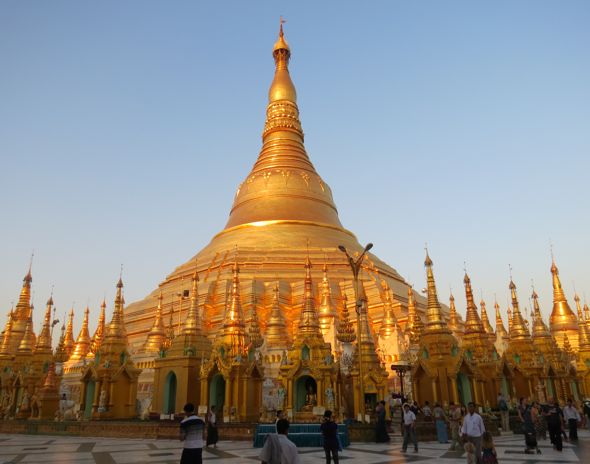
First on anyone’s list in Yangon is the Schwedagon, a massive gold stupa that towers over the southern part of the city. I got my first view at night, as it shimmered across the lake near my hotel. Yangon at night is dark – and this dominated the landscape.
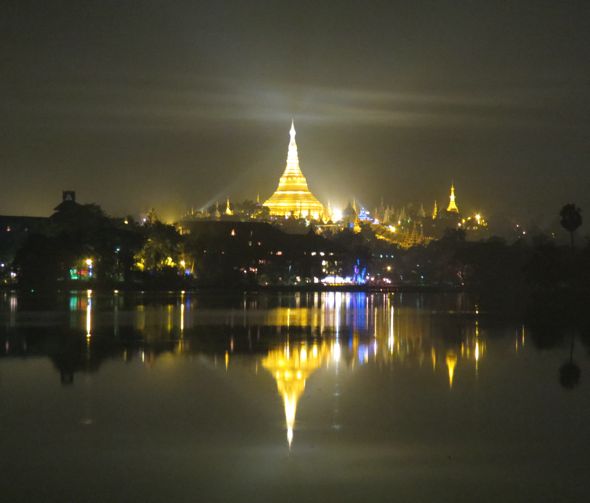
Simply, it’s outstanding. The brilliance of the stupa is overwhelming, to the point of distraction. Its inaccessibility makes it even more enticing, drawing your eye away from the small temples that ring its exterior, devoted to Buddhas for each day of the week. “My” Buddha, which corresponds to one’s day of birth, is Friday. The good news is that he is the Buddha of contemplation, the bad is that his symbol is the guinea pig. Sadly, one of the most dazzling parts can’t really be seen – the jewels on top glitter from afar, including the 78-karat diamond that I’m sure would have made Elizabeth Taylor happy.
But there are also large-scale projects that seem to have come straight from the pen of a totalitarian architect. One of the local lakes is dominated by the Karaweik Palace, a modern representation of a mythical ship. It’s large, brightly colored and excessively lit. And after they built it, for good measure they decided to cover it in gold. It served as the backdrop for my dinner both nights in Yangon. Funny view – better food.
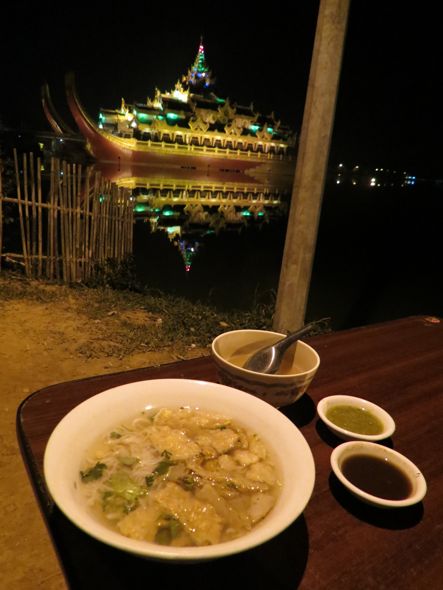
In Burma, many things leave early – though I did my best to avoid them, some early mornings were inevitable. The first was to get my morning flight to Lake Inle. I asked for a 6am call, but woke at 5am. Turns out I answered the phone at hearing the alarm in the next room – insulation is not a strong suit in Myanmar.
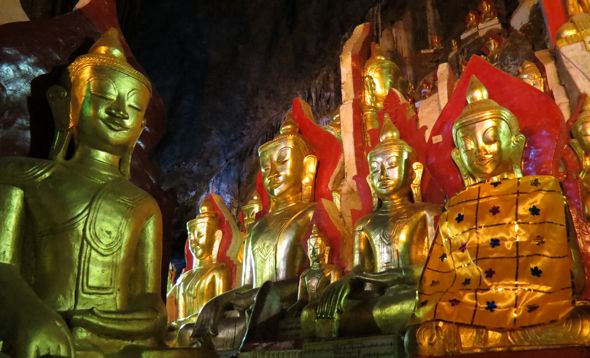
There are a surprising number of private airlines in Myanmar – six domestic, not including the state-run and avoided at all costs Myanma Airways. My first flight was to Heho Airport, pronounced “Hi-Ho” (yes, it was tough to not think of the seven dwarves). To maximize my time at the lake, I hired a taxi and first went to Pindaya, a cave at 4,000 feet with over 8,500 Buddhas, and counting. A little cheesy, but a nice diversion.
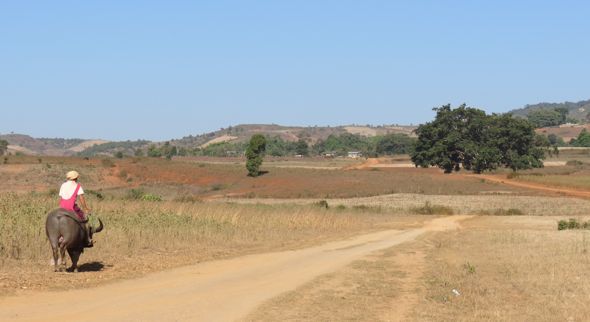
The trip there and back was beautiful, rolling hills and red dirt, though the road was populated only by farm equipment, motorbikes, the occasional taxi and the preferred mode of transport, water buffalo.
But nothing prepared me for Lake Inle. Myanmar authorities push it pretty strongly as an important tourism destination, so I had rather low expectations, but it’s a gorgeous, shimmering landscape, with a broad, tranquil lake girded by mountains on one side, and edging into lush marshland and low hills on the other. Many of the villages are built on the water, as are their gardens.
I found it exceedingly hard to photograph – low, small buildings; tranquil lake; vast sky; stark light; and a persistent haze made it very difficult. The pictures themselves are OK, but can’t fully capture the beauty of the place. The villages, gardens and markets are incredibly picturesque.
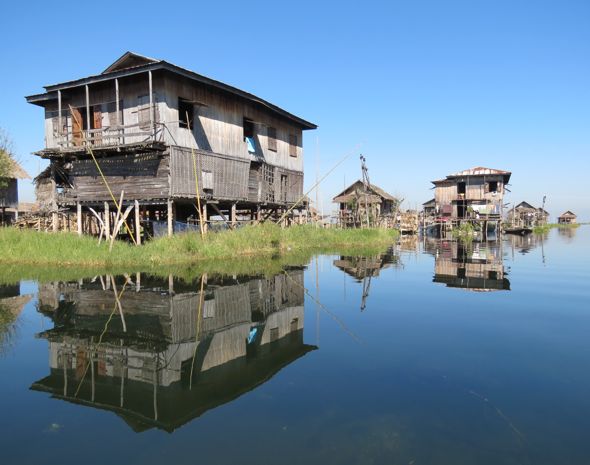
The iconic image of the lake is of its fishermen. They use nets and baskets to catch the small lake perch, and employ a unique one-legged system of steering and rowing their boats. I admit that I stalked them like some sort of crazed paparazzo.
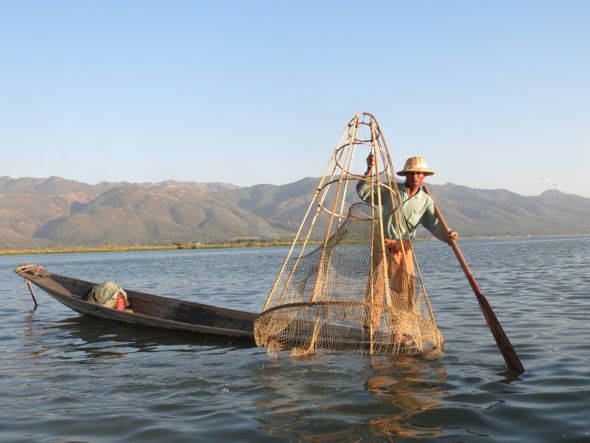
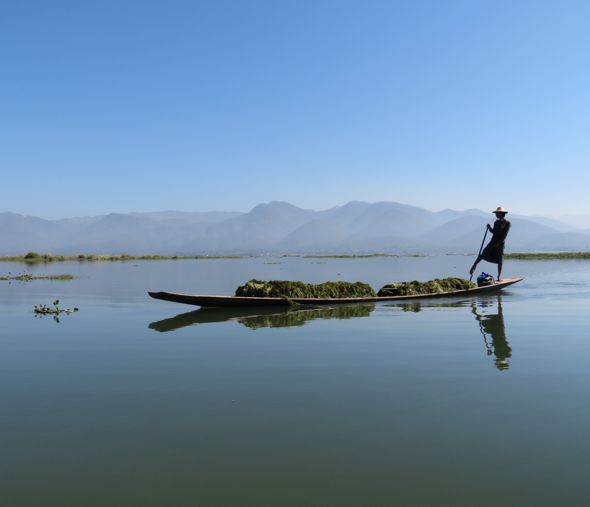
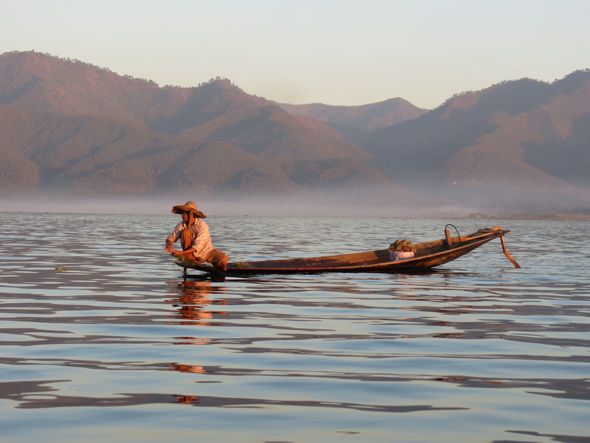
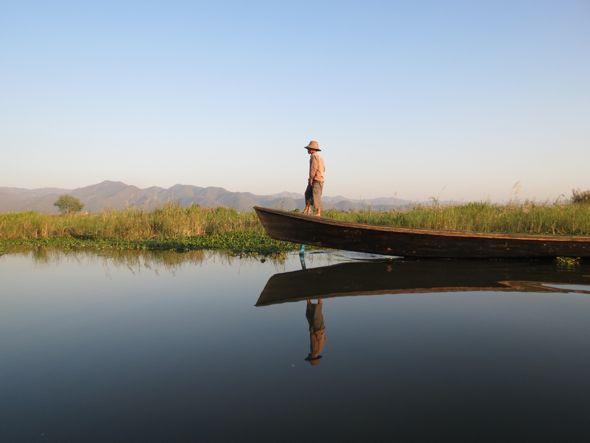
Alas, as with much of Burma, I fear things will soon change. Inle Lake already is almost completely dominated by European tourists. Prices for transport have accordingly increased — the one-hour drive from the airport costs over $30 – exorbitant by SE Asia standards. Luckily, hotels are reflective of the indigenous culture and blend well with the landscape. This was the sunset view from my balcony.
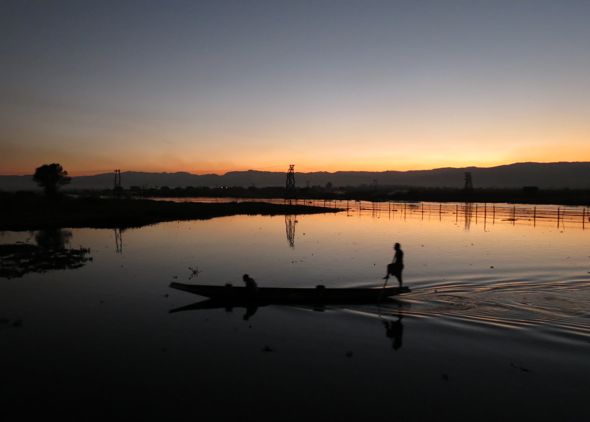
That, and so much more, will change though. There are already the beginnings of a rather weary market-circuit, with vendors making a beeline to all foreigners, though their pricing and negotiating skills are rudimentary. On my first day, my boat driver suggested an itinerary and I agreed, but after seeing lotus weaving, knifemaking, cigar rolling, silversmithing, boatmaking, paper making, and pottery making, I put an end to all that. And garbage, which on a floating landscape is more obvious, will inevitably increase.
Unfortunately, some of the vendors use Paduang women as a lure – the ladies with the brass rings around their necks. Truly depressing site, two older women and two young girls, who do not attend school, making fabrics to lure tourists that want to take their picture. I decided not to take a picture.
Given the number of tourists, the local children have also quickly adjusted, knowing that a cute smile will inevitably attract foreigners and a monetary “present”. Some of the kids approached me with a ready-made “action” pose. I resisted, and instead found this young monk. He showed me the way to a set of hilltop pagodas and I finally got the “monk picture” I’d been looking for.
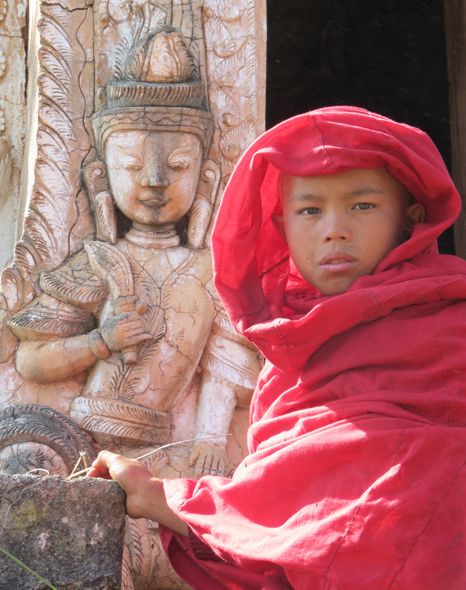
I spent as much time as possible just wandering in the villages, though they can be quite treacherous – with bamboo bridges and catwalks everywhere. I gingerly made my way across one, but almost had to give way to the 90-year-old with a cane and no teeth who threatened to pass me. I also zonked my head pretty severely at one of the local markets – the jagged tin roofs come to about neck level on me, but instead i found a stolid wood beam to leave me a nasty bruise of a souvenir.
 WHERE IS JAVIER?