
Myanmar/Burma – Mandalay and Bagan
Exploration through Burma continues, via plane, train, boat, shared taxi, rickshaw and horse cart. Bagan shines.
After Inle Lake, it was off to Mandalay. The frustrating dichotomy of the place is what sticks with me – historic name and sense of romance, with a massive palace area, surrounded by a moat/lake, dominating the middle of the city, with a looming hill dotted by golden pagodas.
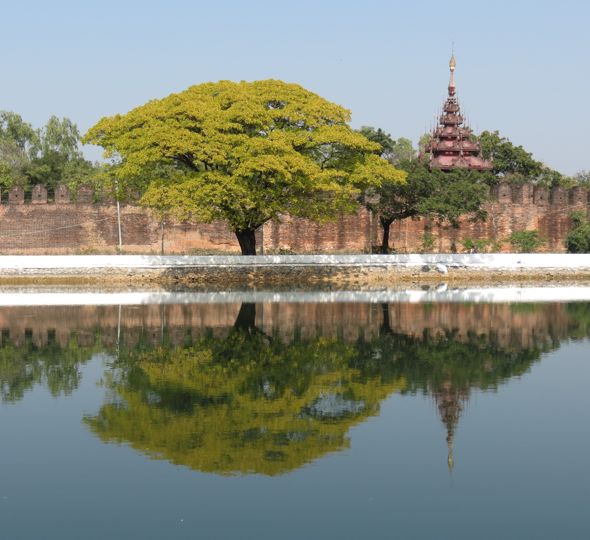
But Mandalay is also saddled with a center city that looks like a pale version of a Chinese third-tier city, replete with sub-standard buildings, garish architectural constructions, yet filled with people with energy and grace. It’s best avoided, but does serve as an important transport hub to the north.
I loathed my hotel in Mandalay – the first time I have said that of all the budget hotels I’ve stayed in during this trip. Overpriced, overstaffed and of strikingly poor quality all the same. I struggled to get the appliances working, and then couldn’t find a working extension in which to plug anything — and let’s not even discuss the promised “wifi”. Though it’s Burma, so iI wasn’t actually expecting internet access in the first place. Sadly, much of modern Mandalay is of this ilk. It has the bones of a grid street system, but little else to recommend it. Yet I did find a great place down the street for food and beverages. I was the only Westerner the first night, and a table near me sent me some fried bread to taste – much appreciated.
Some of you have asked how I am dealing with the separation, the distance and the homesickness. Sometimes needing to be constantly flexible catches up with you, and Mandalay was where it came to a head. This was about halfway through my Myanmar trip, and along with the hotel, I was bemoaning the fact that I had to get up at 2.30am for a train. But I merely stepped back, realized the incredible opportunity I have been given, went to my new favorite restaurant down the block and promptly slept through my alarm, waking at 5am!
But even that wasn’t a problem, as I figured I could catch up with the train in the next city. I tried a couple taxi stands but got nowhere. Luckily a trishaw driver knew of a shared taxi stand, so off I went. Though I missed part of the train trip, on the drive I was able to see the monks making their morning rounds asking for alms. As the sun slowly rose, they seemed to appear in the mist, individually and in small groups, and it was also wonderful to see the people waiting for them, lighting candles to alert them that they had food available. All this as we climbed through the mountains. Oh, and I made the train.
The train was the slow one — well, they are all slow — from Mandalay to Lashio. Flight time 40 minutes. Drive time eight hours. Train time 16 hours. It crosses some spectacular countryside though, including the famed Gokteik Viaduct, 300 ft high and 2300ft long. The train inches along – and some policemen found me a great spot from which to take pictures.
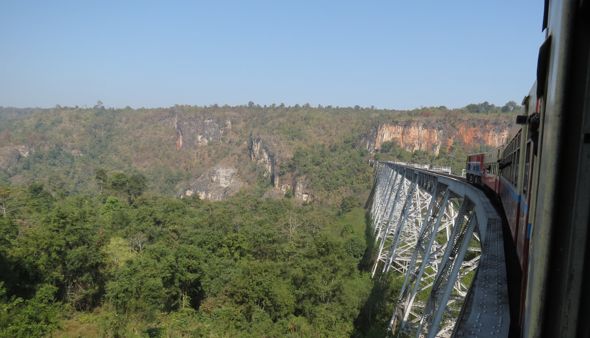
The biggest surprise was after Hsipaw, a popular town for trekking and hiking to see cultural villages, and the point at which the handful of foreigners on the train got off. I had heard there wasn’t much at my destination, Lashio, four hours north, except the airport, so I wasn’t totally surprised. What did shock me was that we meandered for the next couple of hours alongside a broad, placid river essentially devoid of boats, replete with stunning trees, and gentle hills rising from its banks. I’ll admit, I became a little obsessed after seeing slow turns. canyons of greenery, and open vistas, dotted with the occasional thatched hut.
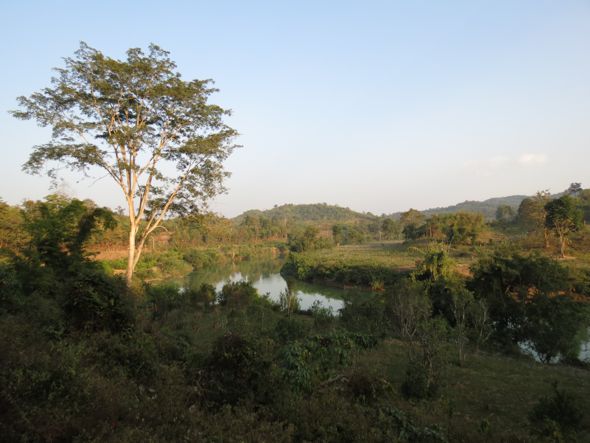
I decided right then that I need to return and kayak that river. Yes, that’s right, kayak the river. So i’m including that tidbit in this email and challenging someone to join me. I’m serious. Heck, if you decide to do it soon, I might still be in Asia. Don’t be shy – let me know. It’ll be a great adventure.
Lashio had the expected charm – none – and I soon found myself at the airport, to later catch my ferry from Mandalay down to Bagan. My gut had told me to skip the ferry – and I was right. The first 45 and final 15 minutes were lovely though.
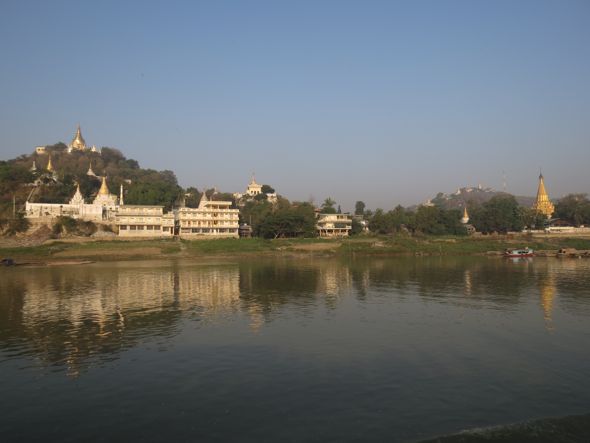
Unfortunately, the nine hours in between were a slog. The upper deck was crowded with sunseekers and I struggled to read through the boredom. It also required a 5.30am wake-up – I should have flown.
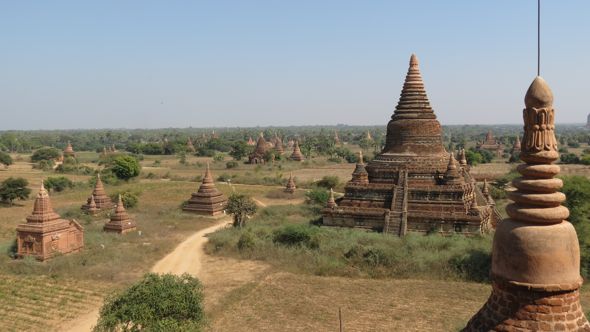
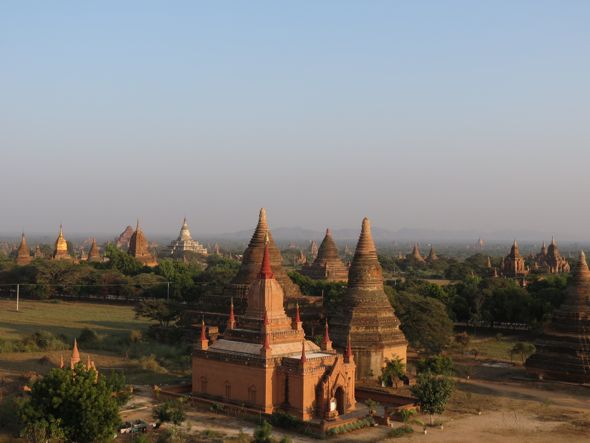
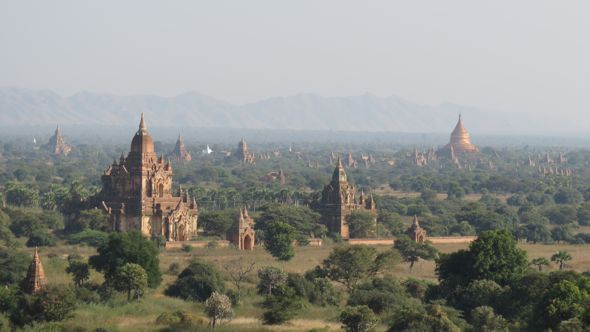
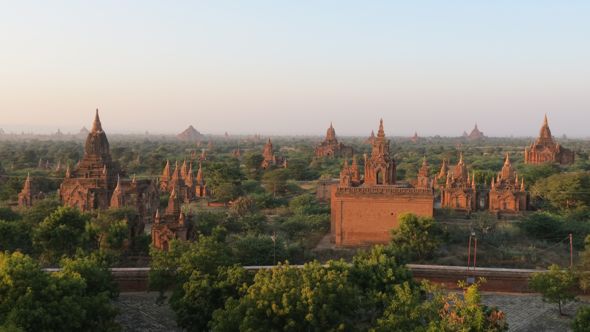
After the ferry, i was tired and a bit cranky, but that quickly dissipated after catching my first glimpse of Bagan. A friend described it this way – “Bagan is what I wanted Angkor to be” and I can completely understand. It is simply breathtaking. A vast desert plain hugging the river that is populated by thousands of temples — as far as your eye can see, it’s temples and more temples. Stupas of every size, some whitewashed, others golden. From just a few feet off the ground, most likely on the terrace of one of the temples, you see a horizon that is filled with them, sprouting amid the trees and bushes. I tried, but I don’t think I can accurately capture it in images. The field of vision is too vast, the depth of field too broad. This is one of those special places you have to visit to understand.
Now a word about footwear. Before one ascends or even enters these temples, you are asked to remove shoes and socks, par for the course for Hindu and Buddhist temples. Problem is, I HATE removing my shoes and socks. And I hate walking in bare feet in any public area. Apparently, the Brits seemed to hate it as well – exempting British officers to the ritual was the second demand made to the Burmese king prior to the 1885 Anglo-Burmese War, coming before the demand that Burma subsume its sovereignty to British India!
I did it at the Schwedagon, though I struggled with the occasional errant step into something best left uninvestigated, and the squishy astroturf-like “carpet” laid down in some areas. But Bagan presented a completely different set of challenges. Though there has been some rather controversial reconstruction in recent years, many of the main temple sites are essentially archaeological ruins dating back many hundreds of years. Some areas are tiled, but the vast majority are filled with broken stone paths. You have to climb through teeny tiny passageways to get to the top, often in complete darkness. Think of it like going to see Angkor Wat or Borobudur barefoot! This is one staircase, though the camera makes it seem far better lit than it was. And yes, that is a brick wall at the end of the staircase – you had to contort your body to get out.
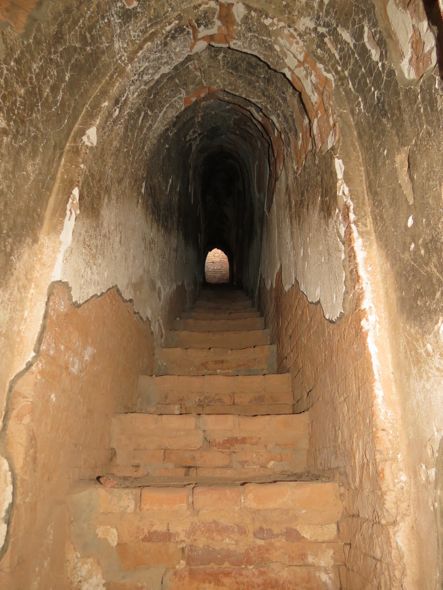
And as with so many ancient monuments, the steps are unbelievably steep – one stupa had steps that were seven bricks high. And it’s not like you can (or should) simply walk around in flip-flops in between the temple visits. The power of Bagan is in the visual sweep and sheer number of its temples. When you see individual ones, that perspective is lost, so you need to step back and walk through the plain to get the proper images. But the plain reminded me much of my childhood in South Texas – dusty, hot, filled with thorned trees, bushes and branches. That is my horse and cart at the bottom of the frame, my preferred transportation across the plain.
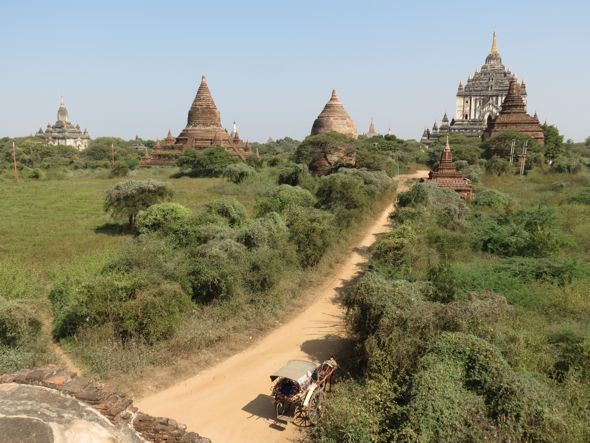
So I wore sturdy sandals, but even those I had to tweeze at the end of the day, removing things that had imbedded in the soles. After walking around barefoot on stones and navigating thorns in the desert plain, I found myself completely spent. Sunset came, I had a quick dinner and I was beat. Frankly, even though Angkor Wat was incredibly trying at times, this was probably the most exhausting place I have ever visited. The sheer range of visual sights, the traversing stone ruins barefoot, the intricacy of the interiors and the vastness of the place.
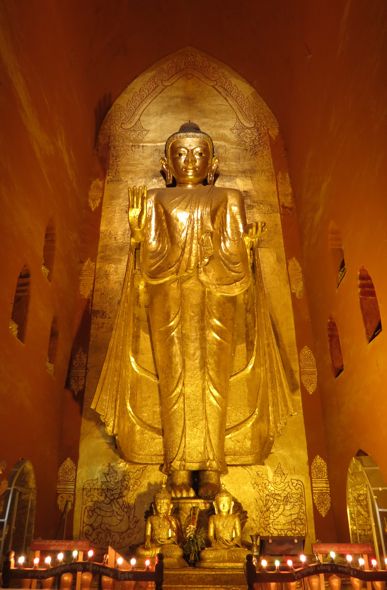
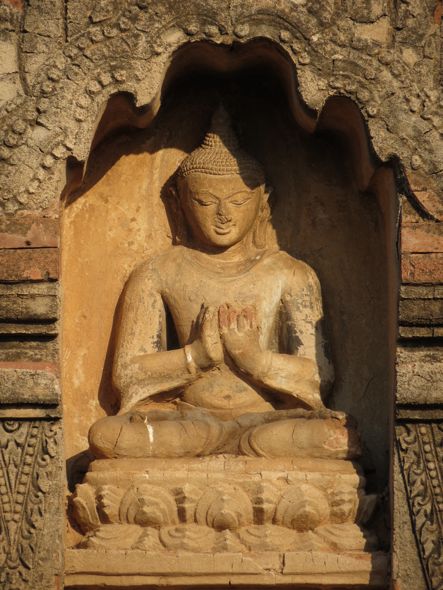
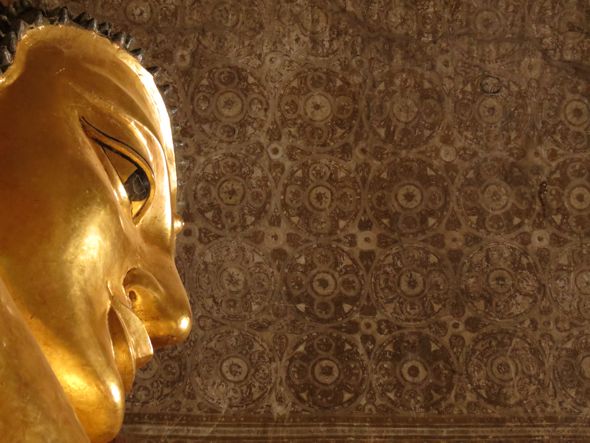
But one can never forget that this complex is dedicated to the Buddha – he’s available in a vast array of shapes and sizes. These are just a sample.
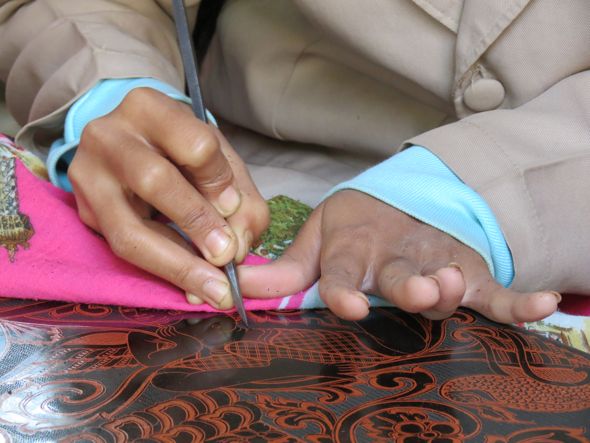
I also finally indulged in a little shopping. The area is famed for its bamboo lacquerware. Constructing, lacquering, etching and coloring these items is incredibly intricate.
On the whole, I would say that if you have any interest in visiting Burma — and you should — come now. Heck, we can canoe the river together! Do it now, before things change radically. Yes, it will be easier in future, presumably with more fixed travel options, greater competition, and more investment, but it will be inexorably changed. I wish I had visited 15 years ago, but coming today was still quite impressive.

Thanks for reading through to the end – I always say everyone needs an editor, and that was certainly true with this tome.
 WHERE IS JAVIER?